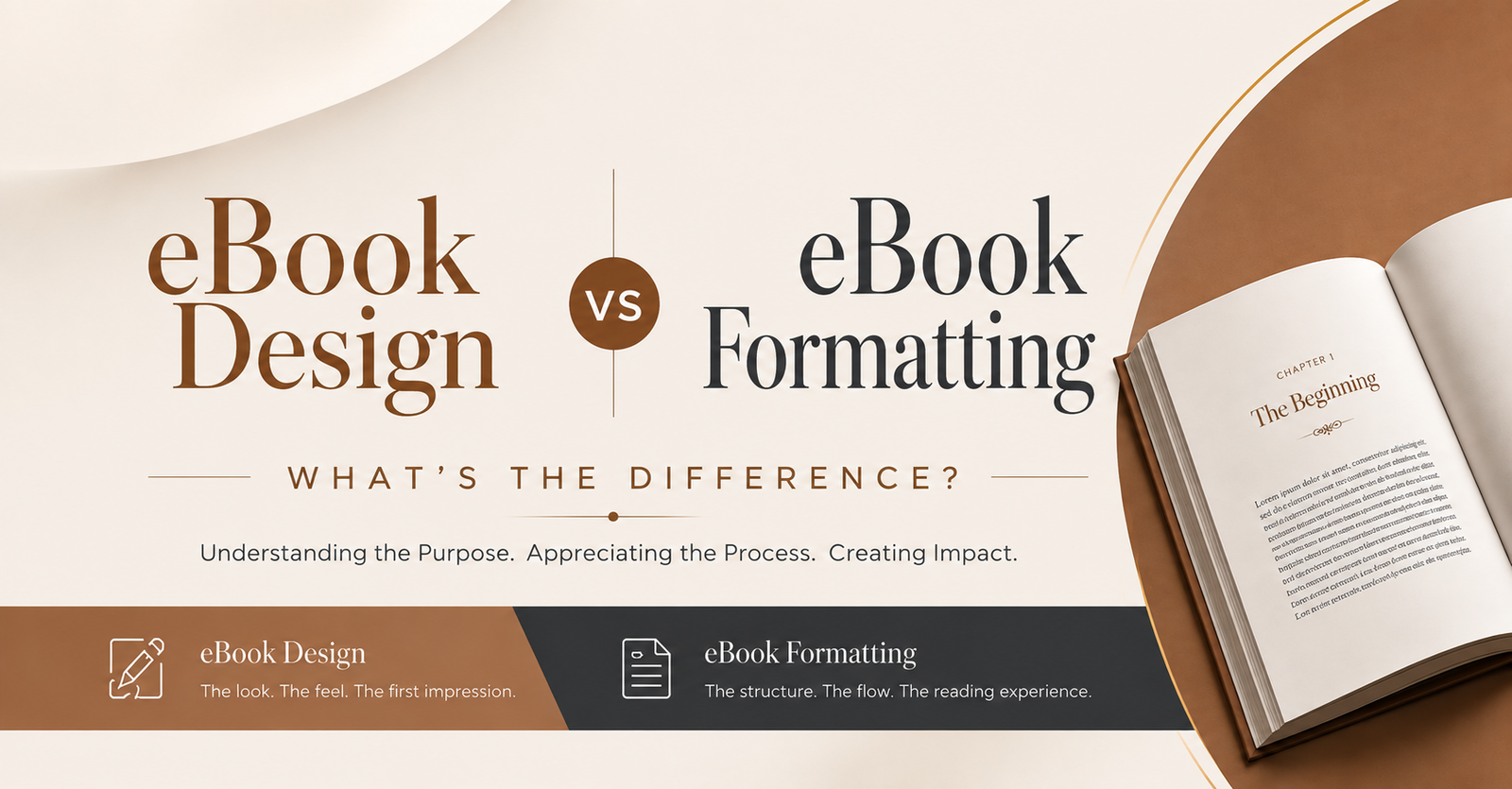
If you’ve ever hired someone (or thought about hiring someone) to prepare your ebook, you’ve probably come across both these terms ebook design and ebook formatting. And honestly, a lot of people use them like they mean the same thing. Spoiler alert: they don’t.
I get this question a lot from clients. They message me saying “I need my book designed” when what they actually need is formatting, or the other way around. So today, let’s clear this confusion once and for all. By the end of this post, you’ll know exactly what each term means, how they’re different, and which one your book actually needs.
Let’s Start With eBook Formatting
Ebook formatting is basically the technical process of taking your manuscript and converting it into a properly structured digital file EPUB, MOBI, or whatever format the platform requires (Kindle, Apple Books, Kobo, etc.).
Think of formatting as the “backend” work. It’s not really about how creative or pretty the book looks. It’s about making sure everything functions correctly. This includes:
- Proper paragraph spacing and indentation
- Chapter breaks that actually start on new pages
- A working, clickable table of contents
- Consistent font sizing across the whole book
- Text that adjusts properly on different screen sizes
- A file that opens without errors on every device
In short, formatting is what makes your book readable and functional. If formatting is done badly, your book might look broken even if the writing inside is amazing.
Now Let’s Talk About eBook Design
Ebook design, on the other hand, is more about the visual and creative side. This is where things get artistic. Design usually includes:
- Cover design (the first thing readers judge your book by, let’s be honest)
- Custom chapter headings and decorative elements
- Choosing fonts that match the tone and genre of the book
- Adding illustrations, icons, or custom dividers
- Creating a visual identity that fits the story or content
- Designing the overall “feel” of the book, not just the function
Design is what gives your book personality. It’s the difference between a plain, boring-looking book and one that feels like it belongs on a bookshelf next to books from big publishing houses.
So What’s the Real Difference?
Here’s the simplest way I explain it to my clients: formatting makes your book work, design makes your book look good.
Formatting is functional. Design is visual. Formatting focuses on structure. Design focuses on style. Formatting is mostly invisible when done right. Design is meant to be noticed.
A well-formatted book with zero design might look plain, but it will still work perfectly on every device. On the flip side, a beautifully designed book with poor formatting might look stunning on the cover, but the moment someone opens it, the reading experience could be a mess broken layout, weird spacing, or a table of contents that doesn’t even work.
That’s why, ideally, a book needs both. Design draws readers in. Formatting keeps them reading without frustration.
A Simple Example to Understand This Better
Imagine you’re building a house. Formatting is like the construction work the foundation, walls, electricity, plumbing. It has to be solid and functional, or the house won’t work properly no matter how nice the paint looks.
Design is like the interior decoration the paint colors, furniture, lighting, and overall vibe of the house. It’s what makes the house feel warm, welcoming, and “yours.”
You wouldn’t want a house with beautiful decoration but a cracked foundation. And you wouldn’t want a perfectly built house with bare, ugly walls either. Books work the same way. You need solid formatting and appealing design to create something readers actually enjoy.
Do You Need Both for Your Book?
This really depends on the type of book you’re publishing.
If you’re publishing a novel or fiction book, formatting usually matters more than heavy design. Fiction readers care more about a smooth reading experience clean text, proper spacing, working chapters. A few tasteful design touches (like a nice chapter heading style) are a bonus, but not always necessary.
If you’re publishing a non-fiction, self-help, or business book, design becomes more important. These books often include headings, subheadings, quotes, charts, or callout boxes, which need a stronger visual structure to make information easier to digest.
If you’re publishing a children’s book or an illustrated book, design is basically the whole point. Formatting still matters, but design takes the lead here since visuals are a huge part of the reading experience.
So the honest answer is: most books benefit from both, just in different proportions depending on genre and purpose.
Common Mistakes Authors Make With This
A lot of self-published authors either skip formatting completely (thinking Word-to-PDF conversion is enough) or go overboard with design without fixing the formatting basics first. Both approaches usually backfire.
I’ve seen books with gorgeous covers and beautifully designed chapter pages, but the actual body text was a mess inconsistent fonts, broken spacing, chapters that don’t start properly. Readers notice this immediately, and no matter how nice the design looks, a frustrating reading experience leads to bad reviews.
On the flip side, I’ve also seen perfectly formatted books that look extremely plain and forgettable, simply because no attention was given to the visual side at all.
The lesson here? Don’t choose one over the other. Understand what your book actually needs, and invest in both formatting and design accordingly.
Why This Matters for Authors (and for Freelancers Like Me)
As someone who works as a graphic designer and helps authors with their ebooks, I always start by asking clients one simple question: “Do you need this book formatted, designed, or both?” This one question saves everyone a lot of confusion later.
Understanding the difference between design and formatting isn’t just useful for authors it’s also important knowledge if you’re offering these services yourself. Clients feel more confident working with someone who clearly understands what they need, rather than someone who just says “yes I can do it” without knowing which service actually solves their problem.
Final Thoughts
At the end of the day, ebook formatting and ebook design are two different jobs that work together to create one final result: a book that looks good and reads smoothly. Formatting builds the foundation. Design adds the personality.
If your book only has one of these done well, readers will notice the gap. But when both come together properly, your ebook doesn’t just look professional it feels like something worth reading from start to finish.
So the next time you’re planning to publish your book, don’t just think about “getting it ready.” Think about whether it needs formatting, design, or a proper mix of both. That one decision can make a huge difference in how readers experience your work.
A Little About Me
By the way, I’m a graphic designer, and ebook design and formatting is actually one of the main things I work on. At Uprisen Publishers, this is exactly what we specialize in helping authors turn their raw manuscripts into premium, professional ebooks that are ready to publish.
We handle both sides of the process. On the formatting side, we take care of clean spacing, proper chapter breaks, working table of contents, and files that run smoothly on Kindle, Apple Books, and every other major platform. On the design side, we work on covers, custom chapter headings, typography, and the overall visual feel of the book, so it doesn’t just work well, it looks premium too.
Most authors come to us tired of dealing with messy Word files or formatting errors, and honestly, that’s exactly the kind of problem we love solving. Our goal at Uprisen Publishers is simple: make sure every book we touch looks as good as the story or knowledge inside it, and gives readers a smooth, enjoyable experience from the very first page.